
SQS Warns EPC Sector of Hidden Risks from “Under-Delivered” Inspections
Posted on 14 January 2026
Unqualified inspectors and partial test witnessing are exposing major infrastructure, energy, and industrial
projects to costly failures, delays, and safety risks.
SQS, a global leader in inspection, quality assurance, and supply chain verification, has issued a formal
industry warning after identifying a growing pattern across the wider EPC supply chain: some inspection
providers are delivering incomplete, unverified, or inadequately witnessed inspections, leaving
EPCs and developers exposed to technical, commercial, and safety risks they may not realise they’ve
taken on.
Reports emerging from clients, vendors, and site personnel indicate that certain providers are:
● assigning inspectors without the necessary discipline expertise,
● only partially attending critical tests, or
● relying on manufacturer-supplied data without independent verification.
This trend does not relate to SQS operations, but reflects broader issues within the inspection
market—especially where cost-cutting and subcontract layering reduce oversight and quality.
We are increasingly being called in to help clients recover situations created by third-party
under-delivered inspections,” says Lisa Roberts, Managing Director of SQS.
“Our concern is not with our own processes—which are independently audited, certified, and
evidence-led—but with the wider practice of cut-price, low-oversight inspection models that ultimately put
EPC projects at risk.”
SQS highlights that these cases originate from the broader marketplace, typically where low-cost
providers reduce their operational standards to offer cheaper day rates. This can result in:
● Inspectors leaving early or attending only part of critical tests (e.g., pressure tests, FATs,
protection verification).
● Limited or missing evidence—no timestamped photos, no calibration data, no serial numbers.
● Inexperienced or non-qualified personnel assigned to specialist inspection scopes.
● Acceptance based on manufacturer declarations rather than independent witnessing.
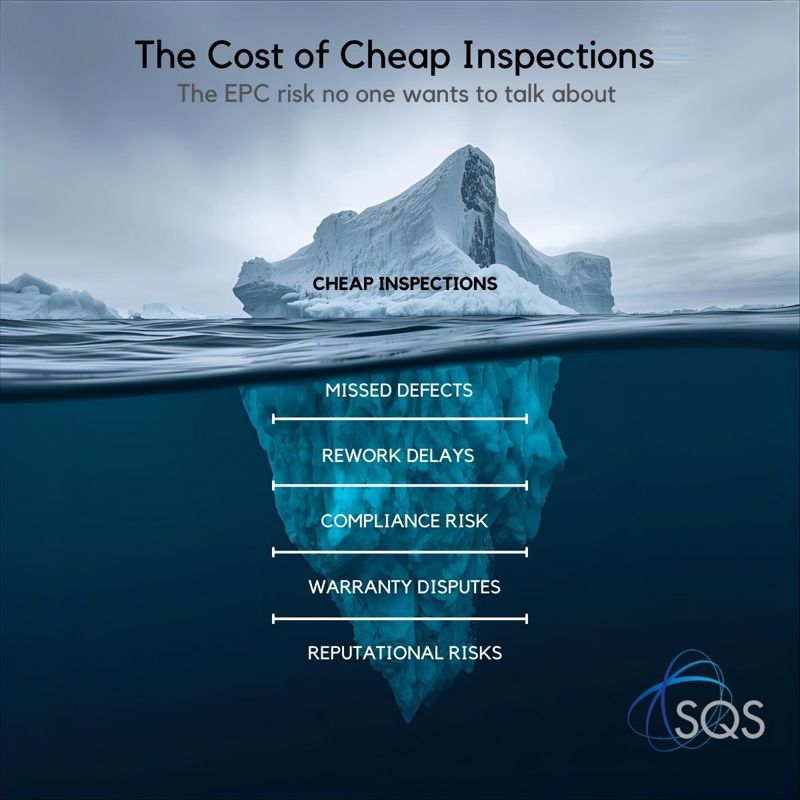
The Consequences for EPCs and Developers When inspections are not properly delivered, significant risks escalate across every project phase:
● Technical risks: missed defects, miscalibrated equipment, unverified tests.
● Safety risks: unverified pressure boundaries or protective systems.
● Schedule risks: late NCRs and rework that affect commissioning and COD.
● Compliance risks: gaps against codes, standards, and client specifications.
● Commercial risks: weakened warranty positions and complex claims.
● Reputational risks: reduced confidence when “verified” equipment later fails.
These problems often surface downstream—when fixes are far more expensive.
SQS Calls for Stronger, Evidence-Based, Transparent Assurance
With over 35 years of operational excellence, a presence in 48 countries, and a network of more than
2,000 qualified inspectors, SQS is advocating for a sector-wide return to disciplined, evidence-led
inspection practice.
SQS sets out the standards it believes should be non-negotiable:
● Inspectors matched and qualified to the specific technical discipline.
● Full-duration witnessing, aligned to ITP hold points and test windows.
● Evidence-rich reporting, including timestamped photos, instrument IDs, and serial numbers.
● Independent verification, not manufacturer-led acceptance.
● Digital transparency, using modern systems to track attendance and evidence.
● Integrated expediting + inspection, ensuring readiness before attendance.
● ESG-driven ethics and accountability, supported by SQS’s B Corp status.
“Our approach is built on transparency, proof, and technical competence,” MD Lisa Roberts added.
“Clients should know exactly who attended, what was witnessed, and where the evidence sits. In a
complex EPC environment, that level of assurance shouldn’t be exceptional — it should be standard.”
Free Resource: Inspection Integrity Checklist - download here:
https://www.sqs.co.uk/inspectionintegritychecklist
To help EPCs and developers strengthen their own oversight, SQS has released a free Inspection
Integrity Checklist, giving procurement teams and project managers a simple, practical tool to verify
whether inspections are being delivered in full.
The checklist includes guidance on:
● Inspector qualifications and discipline-specific experience
● Attendance verification
● Evidence requirements
● Calibration control
● Independence and reporting standards