
Sperra Seaworks and Bardex receive funding from The Crown Estate to advance new infrastructure concept for UK offshore wind
Posted on 12 December 2025
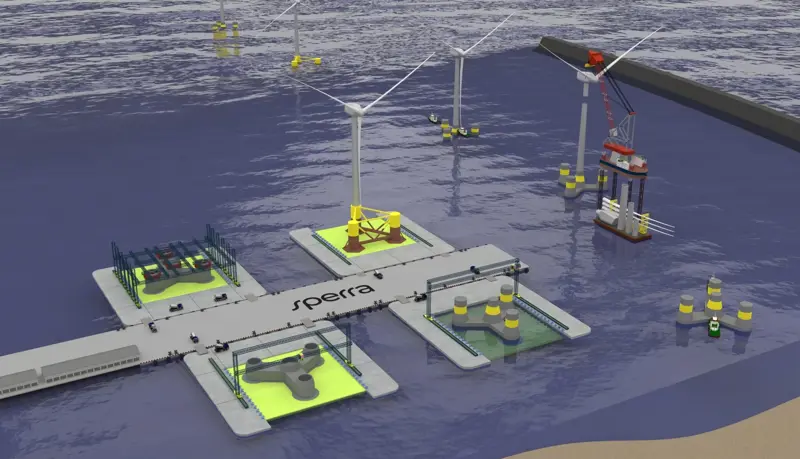
Sperra Seaworks Limited, in partnership with Bardex Energy UK Limited, has been awarded £1,000,000 in funding through The Crown Estate’s Supply Chain Accelerator (SCA) programme to perform early-stage planning and engineering for a concrete Floating Construction Station (FCS) concept intended to expand nearshore manufacturing and assembly capability for UK offshore wind. Additional industry-provided matching contributions are provided by project partners. The work builds upon an ongoing Sperra project funded by the National Offshore Wind R&D Consortium (NOWRDC) to design and build a subscale FCS prototype.
The FCS concept is being evaluated as a deployable infrastructure solution that could be installed at multiple UK ports to support the manufacturing, assembly, launch, and retrieval of floating wind foundations. This technology could alleviate infrastructure gaps in offshore wind ports across the UK. As the Celtic Sea prepares for its first 4.5 GW of offshore wind leasing, the UK must address constraints around port capacity, marshalling space, and heavy fabrication. Information on The Crown Estate’s Celtic Sea programme is available at https://www.thecrownestate.co.uk/our-business/marine/round-5.
The SCA programme supports early-stage supply chain solutions that strengthen the UK’s capability to deploy large scale offshore wind. Details of the programme announcement are available at https://www.thecrownestate.co.uk/news/offshore-wind-supply-chain-receives-further-13m-boost.
Advancing early-stage feasibility for potential UK installation sites
Through SCA, the project team will complete preliminary engineering, evaluate potential installation sites, and develop plans for consenting and construction of the first full-scale FCS in the UK. This work will help determine how the FCS concept could be adapted for different port environments across the United Kingdom and will bring the concept to a stage where future investment decisions can be made.
Sperra Seaworks Limited will lead the work, with Bardex Energy UK Limited providing systems engineering expertise and specialized heavy-lift capability. Additional advisory input will be provided by maritime engineers and naval architects at Haskoning and Keel Marine.
“Offshore wind in the Celtic Sea represents one of the UK’s most significant industrial opportunities,” said Jason Cotrell of Sperra Seaworks Limited. “Support from The Crown Estate’s SCA programme and NOWRDC allows us to complete the early-stage engineering, planning, and feasibility work necessary to evaluate this concept and bring it to an investment-ready stage.”
A deployable nearshore manufacturing approach for floating wind
At the centre of the concept is the Floating Construction Station, a floating platform constructed with marine-grade concrete caissons and integrated with Bardex’s OmniLift® chain jack shiplift system. OmniLift® is an established and operational technology that is currently in service in demanding marine and heavy-industry applications. Learn more at https://www.bardex.com/applications/omniliftoffshorewind/.
“The Floating Construction Station, integrated with our OmniLift® system, provides a practical pathway to simplify how floating wind foundations are handled and deployed,” said Ian Finch, Director, Business Development – EMEA, Bardex Energy UK Limited. “Our technology is proven today in heavy marine applications, and we are excited to support its evaluation for the UK’s floating wind sector.”
The FCS is designed to reduce reliance on large port upgrades, enable repeatable foundation handling operations, support direct launch and retrieval of hulls and substructures, and allow optional integration of advanced manufacturing methods, including 3D concrete printing and slipforming. This approach aims to give UK ports additional pathways to participate in early floating offshore wind deployment.
Port Talbot as a promising candidate location
Although the FCS concept is being assessed for suitability across multiple UK ports, Port Talbot has emerged as one of several promising potential locations due to its industrial waterfront, deep water access, and role in wider Celtic Sea planning. The port is already under evaluation through the UK Government’s Floating Offshore Wind Manufacturing Investment Scheme, FLOWMIS, and is part of the Celtic Freeport initiative.
“Port Talbot has an important role to play in enabling floating wind in the Celtic Sea,” said Andy Reay, Head of Offshore Wind, Associated British Ports. “We welcome early-stage technical work that helps evaluate feasibility, regulatory pathways, and the potential contribution of new infrastructure concepts such as the Floating Construction Station.”
Supporting UK floating wind supply chain growth
Strengthening domestic capability to fabricate, assemble, and launch floating foundations is a strategic priority identified by UK Government, The Crown Estate, and the Offshore Renewable Energy Catapult. ORE Catapult summary reports on floating wind supply chain needs are available at https://ore.catapult.org.uk/resource-hub/analysis-reports.
The SCA supported work will help determine the technical case, regulatory considerations, and commercial viability for deploying an FCS Facility at Port Talbot or other UK ports. The FCS Facility is designed to support both concrete foundation manufacture and steel foundation assembly, creating flexible capacity that can adapt to developer design choices and strengthen the UK’s floating wind supply chain. Cotrell emphasized the importance of building long term capacity.
“This work is about creating infrastructure that can scale with the UK’s floating wind ambitions,” Cotrell said. “The evaluation will allow us to understand where the FCS concept can contribute most effectively across the UK port network.”