
Durham Lifting Completes Controlled Wire Rope Destruction Test at Britannia Test House
Posted on 19 May 2026
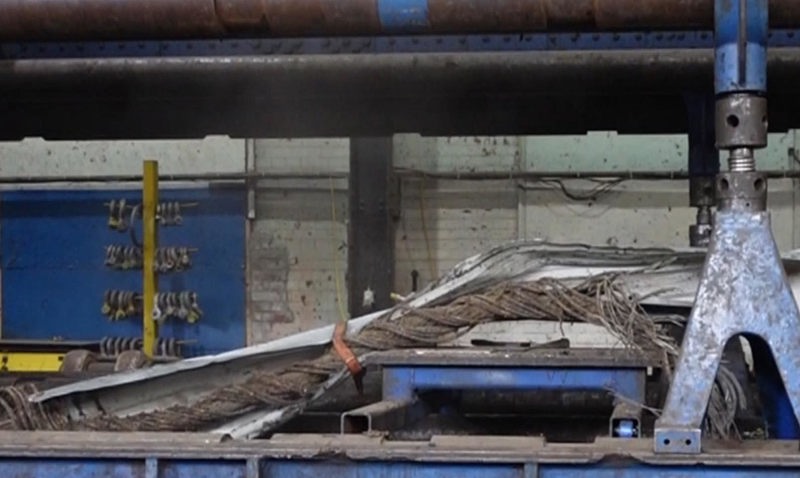
Durham Lifting has completed a controlled destruction test on a 103mm diameter steel wire rope at its Britannia Test House facility, using the site’s H2 Avery horizontal test bed.
The work was carried out as part of an ongoing programme for a client, focused on understanding how a wire rope assembly behaves under increasing tensile load, particularly as it approaches failure.
The rope was installed on the test bed and loaded progressively under controlled conditions until destruction was achieved. The test was fully monitored throughout, with the rope’s response recorded across the full load range.
As the applied load increased, visible changes in the rope were limited. At higher load levels, behaviour remained relatively consistent, with the transition from loaded condition to failure occurring over a short interval.
The test provided a clear indication of how the rope behaves as it reaches its limit under load. For the client, this provides a more practical understanding than can be taken from certification data or calculations alone.
Joshua Muir, Testing Manager at Durham Lifting, said the focus of this type of work is to understand behaviour under load rather than rely solely on theoretical values.
“Taking a wire rope to destruction in a controlled environment gives a clear indication of how it behaves as load increases. That information can then be used to support decisions around use, inspection, and risk management.”
Testing like this is used across the lifecycle of steel wire rope, from initial manufacture through to in-service assessment.
For manufacturers, it is used to verify breaking load, confirm construction, and support compliance with standards such as BS EN 12385. It also supports batch validation and helps identify defects that may not be visible during inspection.
For ropes in service, testing to destruction can be used to assess residual strength following fatigue, corrosion, and wear. It also supports end-of-life decisions, validation of inspection methods, and investigation work following failure.
The test was carried out on Durham Lifting’s H2 Avery horizontal test bed, which provides working loads of up to 1250 tonnes in tension, with destruction testing capability up to 1143 tonnes. The facility also includes additional horizontal and vertical test beds, along with in-house wire rope preparation services including serving, brooming, and socketing.
Britannia Test House, originally constructed in 1926, continues to support testing across lifting equipment, structural components, and wire rope assemblies for clients operating in offshore, marine, construction, and heavy engineering sectors.
Inspection can identify visible deterioration, but only destructive testing confirms how a wire rope will perform under load. This provides the data needed to support decision-making in critical lifting applications.
With high-capacity test equipment, in-house wire rope preparation, and experience across critical lifting applications, Durham Lifting supports clients with testing that reflects real operating conditions.