How CAN Group Reduced Risk and Downtime in FPSO Ballast Tank Inspections
Posted on 25 September 2026
Delivering Safer, Faster Inspections Through Robotic Technology
For offshore operators, maintaining asset integrity is a constant balancing act between safety, operational continuity and inspection quality.
For CAN Group, the challenge was clear. Traditional water ballast tank inspections often require significant preparation before an inspection can even begin. Draining tanks, installing access equipment and managing confined space entry all introduce cost, time and operational disruption.
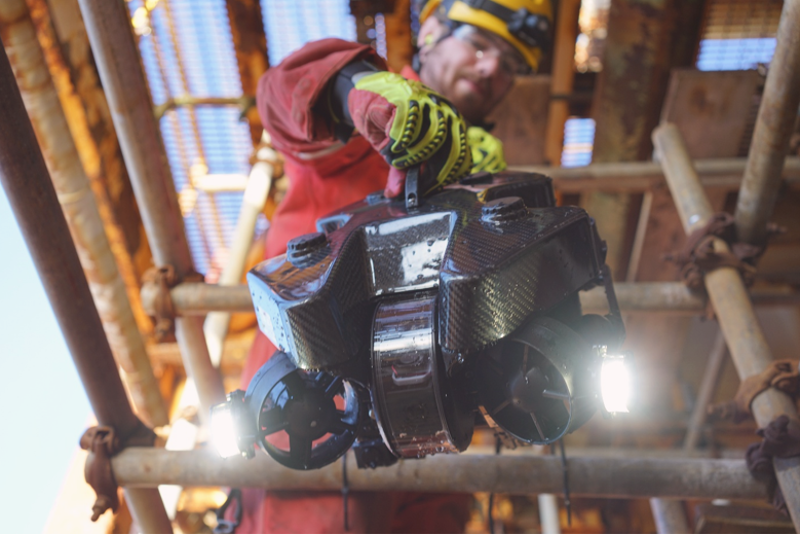
To address these challenges, CAN Group has expanded its use of remote inspection technologies, deploying the PHOTON ROV as part of its inspection toolkit for FPSO water ballast tank inspections.
The result is a safer, more efficient inspection approach that reduces personnel exposure, minimises disruption to operations and delivers comprehensive digital inspection records.
"Remote inspection technology is changing how we approach ballast tank inspections. By reducing the need for personnel to enter hazardous environments, we're able to deliver inspections more safely and efficiently while maintaining the quality of information our clients expect."
Leum Renney, Remote Inspection Services Lead, CAN Group
Project Highlights
• Ballast tank inspections completed without draining tanks
• Reduced confined space entry requirements
• Significantly reduced inspection preparation time
• Smaller offshore inspection teams
• Minimal disruption to ongoing operations
• Full digital inspection records and video capture
• Integrated ultrasonic thickness measurement capability
• Improved inspection repeatability and traceability
About CAN Group
CAN Group is a leading provider of asset integrity, inspection, advanced non-destructive testing and industrial services to the global energy sector.
Celebrating more than 40 years in operation, the company supports offshore and industrial assets across the UK Continental Shelf and international markets, including North America and West Africa.
Its specialist Remote Inspection Services team deploys UAVs, ROVs and other robotic technologies to inspect hazardous, inaccessible and confined environments, helping clients improve safety, reduce operational disruption and maintain confidence in their asset integrity programmes.
The Challenge
Water ballast tanks are critical to the safe operation of FPSOs and offshore assets. Regular inspections are required to assess structural integrity, identify corrosion and support marine class compliance.
Traditionally, these inspections involve extensive preparation before inspectors can enter the space.
Typical activities include:
• Ballast transfer operations
• Tank draining and cleaning
• Ventilation and gas testing
• Lighting installation
• Rope access or scaffolding
• Confined space permits
• Rescue and standby arrangements
These activities can take days to complete before any inspection work begins.
"Traditional ballast tank inspections require extensive preparation before the inspection itself begins. Access arrangements, safety controls and tank preparation all add time and complexity to the work scope."
Leum Renney, Remote Inspection Services Lead, CAN Group
For CAN and its clients, reducing these requirements presented an opportunity to improve safety, efficiency and operational continuity.
A Different Approach
Reducing the requirement to prepare tanks for personnel entry, CAN deploys the PHOTON ROV directly into the flooded ballast tank.
This allows inspections to be completed while the asset remains operational, removing many of the activities associated with conventional inspection methods.
The system provides inspectors with access to internal structures, bulkheads, plating and hard-to-reach areas while reducing the need for people to enter confined spaces.
"We can typically deploy the system without having to drain the tank, limiting disruption to asset operations."
Leum Renney, CAN Group
For CAN, the technology itself is only part of the story.
The objective is to deliver the same inspection outcome while reducing risk and improving efficiency.
" ROV’s are tools that help to gather inspection data. The technology allows our inspectors to complete the work scope more safely and efficiently, without sending personnel into a hazardous environment."
Leum Renney, CAN Group
From Days to Minutes
One of the most significant benefits of remote ballast tank inspection is the reduction in preparation requirements.
Traditional inspection campaigns can typically require several days of tank preparation before inspection activities begin. Tanks must be drained, ventilated and made safe for personnel entry. Access equipment must be installed and safety arrangements put in place.
Using a remote inspection approach, CAN is often able to begin work within minutes of gaining access to the tank.
"Following a safety meeting, our team are able to deploy the technology almost immediately after the tank's been opened up. – Whilst each work scope is different, we're typically deploying within minutes, not days or weeks."
Leum Renney, CAN Group
The approach reduces inspection lead times and allows clients to minimise disruption to ongoing operations.
Improving Safety Through Remote Inspection
Reducing personnel exposure remains one of the primary drivers behind CAN's adoption of robotic inspection technologies.
Where conventional inspections require personnel to enter confined spaces, remote inspection systems allow much of the work to be completed without direct entry.
The benefits include:
• Reduced confined space exposure
• Reduced working at height
• Reduced access equipment requirements
• Smaller offshore inspection teams
• Lower overall operational risk
In many cases, inspection activities that may previously have involved multiple personnel and significant support infrastructure can now be delivered by a two-person team.
"Anywhere we can reduce the risk to personnel, whether it's confined space, working at height or other hazardous environments, then we will look to implement robotic systems."
"A typical composition is a two-man team. We have the pilot and the inspector."
Leum Renney, CAN Group
Better Data, Better Decisions
Remote inspection technology also changes the way inspection data is collected and reviewed.
Rather than relying solely on written observations and selected photographs, CAN captures a complete digital record of the inspection through continuous video and image capture.
This provides clients with:
• Full inspection coverage records
• Improved traceability
• Enhanced reporting
• Easier stakeholder review
• Historical comparison between inspection campaigns
• Greater confidence in inspection findings
"We can demonstrate through the video capture that we've covered the asset. We have all the raw images and data for post-analysis and further interrogation."
Leum Renney, CAN Group
The ability to review historical datasets also improves repeatability and supports long-term asset integrity planning.
"It's recordable and repeatable. If anything, potentially needs to be revisited, we can look at previous inspection history data and compare it with future inspections."
Leum Renney, CAN Group
Integrating Ultrasonic Thickness Measurement
Many ballast tank inspection programmes require ultrasonic thickness measurement alongside visual inspection.
When CAN identified the need for a compact inspection platform capable of performing both functions, Spectis Robotics worked closely with the team to develop a bespoke solution.
Through a collaborative development programme, Spectis Robotics supported the proof-of-concept trials and integration of a Cygnus ultrasonic thickness measurement system onto the PHOTON platform.
The result was a compact inspection solution capable of gathering both visual and thickness measurement data during the same deployment.
"Spectis Robotics were instrumental in being that direct link and helping provide a solution."
Leum Renney, CAN Group
This capability enables CAN to deliver visual inspection and NDT requirements through a single inspection campaign while maintaining the operational benefits of remote deployment.
Responsive Support When It Matters
Offshore inspection campaigns often operate within tight schedules, where equipment availability can directly impact project delivery.
CAN highlighted the importance of responsive technical support and local expertise when deploying specialist inspection technology.
"The after-sales support from Spectis Robotics and the manufacturer was exceptional."
"We need solutions quickly. That's where the support from Spectis Robotics has been very good."
Leum Renney, CAN Group
Results
The adoption of remote inspection technology has delivered measurable benefits for CAN Group and its clients.
Operational Benefits
• Reduced inspection preparation time
• Reduced personnel exposure
• Smaller offshore inspection teams (where possible)
• Reduced scaffolding and rope access requirements
• Minimal operational disruption
• Faster mobilisation
• Improved inspection coverage
• Repeatable digital inspection records
• Integrated visual inspection and NDT capability
• Enhanced reporting and asset history tracking
"We're always striving to look for smarter, more intuitive ways of carrying out tasks."
Leum Renney, CAN Group
Looking Ahead
Remote inspection technology continues to play an increasingly important role in CAN Group's inspection delivery strategy.
By combining inspection expertise with advanced robotic systems, CAN is helping clients reduce risk, improve efficiency and maintain critical offshore assets with less disruption to operations.
As demand for safer and more efficient inspection solutions continues to grow, remote inspection technologies are set to remain a core part of how CAN delivers asset integrity services across the global energy sector.
"We’re committed to providing smart solutions that will deliver value to our clients, improve safety, increase efficiency or reduce operational impact.
Leum Renney, CAN Group